

I want to ask you something, and I mean it as a question rather than a speech.
At the Brixton Traders & Community Association, we are in the middle of the unglamorous part of buying back Brixton market: going through the assets, drafting the governance, and defining what “community ownership” will actually mean in the rules a regulator will hold us to. And there is one phrase we keep writing down that stops me every time. For the benefit of the community. It sounds obvious. Then you have to define it — and the moment you define it, you’re deciding who counts.
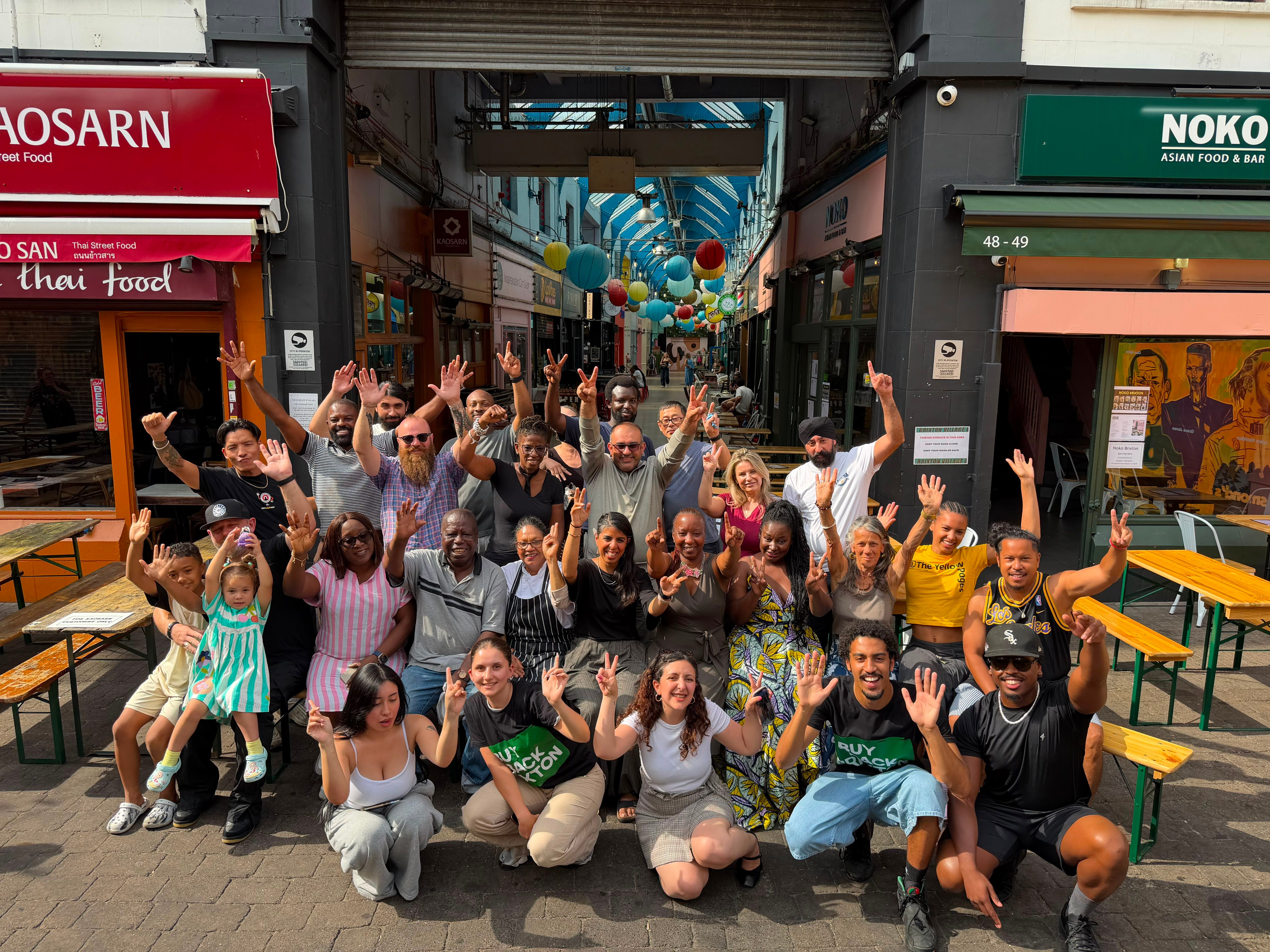
So I’ve started paying attention to what people mean when they say “the community.” I’m interested in how you think about it. Who do you have in mind? And who might we be missing?
How people think about community
When someone talks about “the community” of a place, they’re usually reaching for one of a few different ideas without saying which.
Most often, they mean the people who live there — the residents, especially those who have been there the longest. On this view, community is defined by where you sleep, and it quietly draws a line between locals and everyone else: visitors, commuters, and, tellingly, businesses.
Sometimes they mean a people, not a postcode — the Jamaican community, the Windrush generation, the African, Portuguese, or Latin American community. Here community means shared origin, culture and history: people who may be spread across south London but have one place they think of as theirs. Brixton is that place for several communities at once, which is why the elders and the Windrush families often come first when people list “the community” here.
Sometimes they mean the organised groups — the tenants’ associations, faith groups, community organisations and social impact charities that speak for residents and sit in the meetings. This is often who a council or a funder means by “consulted the community.”
Sometimes they mean the future — the young people. Whose Brixton will this be in twenty years? Who is growing up here now, and what will they inherit? When people say “we have to do this for the community,” they might have a particular group in mind.
And underneath all of these is the oldest meaning: community as the web of people who know each other, rely on each other and gather together. On this view, community isn’t a category of people at all. It’s the relationships — and relationships need a place to be lived out. Sociologists call it a “sense of community”: you belong, you have a say, your needs are met by one another, and you share something felt.
Even the law recognises this last sense. When Brixton Market was listed as an Asset of Community Value, the test wasn’t which groups use it. It was whether the place furthers the social wellbeing and social interests of local people. It does. That’s why it was listed.
What I see when I look at the market
Here is what strikes me: in Brixton, every one of those meanings runs through the market.
The residents? Come and stand in the market on a Saturday and see who is behind the counters and who is in front of them. The people of Brixton? The market is where the Windrush generation built a living when other doors were closed, and where their children and grandchildren, and the communities that came after, when Brixton was not worth much, a lot still are trading now. The organised groups? Ask where their members meet, eat and shop. The young people? The market is where a lot of them grew up — the food after school, the Saturday job, the first time they saw someone who looked like them running their own business — and young organisers from the Advocacy Academy have been part of this campaign from the start. And the web of relationships — the sense of community — that is what the market is. It’s the one place in Brixton you go without an appointment, where the elder, the teenager, the new arrival and the councillor pass through in the same hour.
The belief I bring to it — tell me if you think it’s wrong
Here is the conviction I carry into the governance meetings. The traders are not a business interest sitting inside the community. The traders are the fabric of it — the threads that, woven together, make the cloth everyone else wears.
Look at what that means on the ground. Stafford at Healthy Eaters isn’t a caterer to the Jamaican community. He is at the core of it — 13 years of feeding people, and the place a whole slice of Brixton goes to find each other. Etta at Etta’s Seafood Kitchen and Brian at Fish, Wings & Tings are the same. People don’t just come for the fish; they come because Etta and Brian will be there, and so will everyone else. Kumasi Market (Ghanaian Food store) has been trading for 30 years, and for my Ghanaian family, this has been the heart of our community for three decades. On Electric Lane, Impact Brixton, a coworking space I started eight years ago, there are 400 members — founders, freelancers, young people starting things.
Not all of these places were set up as a community project. Nobody funds them to be hubs. They are hubs because somebody opened a unit and kept it open, year after year, and the community organised itself around them. Each one is a thread. Woven together they make the fabric — the hub of hubs, the one place where all of Brixton’s communities sit side by side.
Without traders, there is no Market, and without a market, there is no community.
And the fabric is how the next generation gets woven in. Every business in this market started small. I have watched traders start with one counter and end up employing people, supplying other businesses and training whoever comes next — and “whoever comes next” is usually a young person from round here. That’s the fabric doing what fabric does: carrying the pattern forward.
So is community just everyone?
No — and it’s worth being honest about that. If the community is everyone, then nobody in particular is responsible for it, nobody in particular is accountable to it, and “community ownership” is just a nicer word for nobody’s ownership.
The way I’ve come to think about it is this. There are two different questions hiding inside “who is the community,” and they have two different answers. Who is the market for? Everyone who walks in. The tourist eating at Etta’s for the first time, the office worker on a lunch break, the family visiting from Brooklyn — all welcome, always. That’s what a market is. Who does the market belong to? The people in a relationship with it — the ones who show up, who are known, who would notice if it were gone and whom it would notice missing. That’s a smaller group, and it has edges. It’s the traders and the people the traders serve week in, week out. It’s Brixton, and Lambeth around it.
Being outside the community isn’t a judgement, nor is it exclusion from the market. It just means the market isn’t yours to steer. The regular from Croydon has a stronger claim than the person who came once from round the corner. Money without relationship — an owner who never comes — has no claim at all. And organisations aren’t community; people are. That’s why our members are individuals, not institutions.
The rules have to turn that fuzzy, honest edge into a hard line somewhere, and the line we’ve drawn — traders, plus anyone who lives, works or studies in Lambeth — will be slightly wrong at the margins, because every line is. The members can move it. Which is exactly why I’m asking.
Who are we forgetting?
That’s where we’ve got to. Now the part I actually want your help with.
Every definition draws a line, and every line leaves someone on the wrong side of it. When I look at ours, questions come up that I don’t have great answers to. What about the people who worked in the market for years and left — the staff, the family members behind the counter? What about the traders who left and would come back if they could? What about the regulars who don’t live in Lambeth — the families who drive in from Croydon or Lewisham every Saturday because this is still their market? What about the street traders on Electric Avenue and Pope’s Road, who are the market as much as anyone under the arcade roofs but sit outside our boundary? What about the elders who can’t get down here as often as they used to, and so aren’t in the room when we ask the room? What about the under-16s, who have no vote but arguably the biggest stake?
Some of these we’ve already tried to answer in the rules. Some we haven’t. And some I probably haven’t even thought of — which is the point.
So: when you say “the community,” who do you mean? Who do you picture? And when you look at what we’re building — a market owned by its traders and its people, one member, one vote, locked into community hands for good — who is missing from that picture?
Tell me. Reply to this. Come to the next community rally.
Who will we be forgetting?
GVDP